-----BEGIN PGP SIGNED MESSAGE-----
Hash: SHA1,SHA512

Hello,

I'm transitioning from my 2003 GPG key to a new one.

The old key will continue to be valid for some time, but I eventually
plan to revoke it, so please use the new one from now on. I would also
like this new key to be re-integrated into the web of trust. This message
is signed by both keys to certify the transition.

The old key was:

pub   1024D/FC7F6D0F 2003-07-10
      Key fingerprint = E6A8 8BA0 D28A 3629 30A9  899F 82D7 DF6D FC7F 6D0F

The new key is:

pub   4096R/90BDD207 2012-01-06
      Key fingerprint = 6B85 4D46 E843 3CD7 CDC0  3630 E0F7 59F7 90BD D207

To fetch my new key from a public key server, you can simply do:

  gpg --keyserver pgp.mit.edu --recv-key 90BDD207

If you already know my old key, you can now verify that the new key is
signed by the old one:

  gpg --check-sigs 90BDD207

If you don't already know my old key, or you just want to be double
extra paranoid, you can check the fingerprint against the one above:

  gpg --fingerprint 90BDD207

If you are satisfied that you've got the right key, and the UIDs match
what you expect, I'd appreciate it if you would sign my key:

  gpg --sign-key 90BDD207

Lastly, if you could send me these signatures, i would appreciate it.
You can either send me an e-mail with the new signatures by attaching
the following file:

  gpg --armor --export 90BDD207 > timojyrinki.asc

Or you can just upload the signatures to a public keyserver directly:

  gpg --keyserver pgp.mit.edu --send-key 90BDD207

Please let me know if there is any trouble, and sorry for the inconvenience.

(this post has been modified from the example at
http://www.debian-administration.org/users/dkg/weblog/48)

-----BEGIN PGP SIGNATURE-----
Version: GnuPG v1.4.11 (GNU/Linux)

iEYEARECAAYFAk8GuZoACgkQgtffbfx/bQ9nqACglWyHnDTFQfdKmz8OCd3oL6iR
hcEAmgKJ7RZsgwxwkRGPhygy5y1Ztb+3iQIcBAEBCgAGBQJPBrmaAAoJEOD3WfeQ
vdIHdVQQAMT1yvIogzbtK6sUnWqwbrXI9pDEFk7AzJTb80R+wzxsw7gu9gcBDk8G
BL2O26GKUqKWA3ytuApSl42FJam/Lusi9npT3XNkmHs6FaBMNuLYrqEXmCwXwWr/
OrLyeeLiF4yxgbNWbv+600BqAWqFlo6NeTgQKsJWtCjR3RVMxX3R8nzjDnKJuF+z
c6+2JKBWyx/HVUKcJpJrFDDR36HRFvVJomTuma2JCQ/RAl9vzAguqNYOi1QkuuQv
EF1gXH7gLifukGuwquP1DHP6SWWkj77jtRWr5ewC0xymbrArzAwKbvMQl3VpKBHh
MmpJjYP3ECyL14AKi/TY2Lidi0Sf6yqFMcPcreoih01N0OU0NXmD4IrHMT24/ssb
okDUe1o3YImjGq1jTACvlzC8s54EfLsqDgSP98SGVpuoDqPJUwVk4nuHj8q0vDSs
qZox26gVwB2FAOUi1BFiZbIzM5rsyYfCGyWUGiAwBFf54lYRAeCDCt8iAOOL1Ov/
TumIGYdLoXnDuOJq1VjXLGx2OFDrpyU8SPGoa3zNEVz39tgxQ48ASJEqcqt7HvBy
IW+TTsMLdJ1Ait9aCM3mzzr1iwP8TrL0qUsdRLOE6AKdAqocIfqXY8OeDKhbUiOJ
CXWk5q3xheK3sDWUXX7J63bAAUH4jFnpQEOVMJKBUNMKsWa0iXDS
=mklN
-----END PGP SIGNATURE-----
Friday, January 06, 2012
I have a new GPG key


Thursday, November 17, 2011
On discussing free software mobile phones
Since I think I just summarized a few thoughts of mine well at LWN, I'll copy-paste it here:
So there. For more civilized discussion.
I can grumble about Android from time to time, but I do not say that it sucks. Extreme views are what are annoying. Android is what it is and it's great as it is, even though it could be different as well.
When it comes to discussing about free software and mobile phones, I'm especially annoyed by two types of comments:
1. People essentially saying that there is no value in an open project, ie. free software code dumps should be enough for everybody. I'm interested in the long term viability of free software projects, and it is hard to have successful projects without there being all sorts of factors that make up a good project - like transparency, inclusion, meritocracy. Even though the mobile projects have had little resources and a hard road, it's not useful to forget about these goal in the longer term. For example Debian, Mer, SHR, KDE Plasma Active have some of these in the mobile sector. I hope the best for them (and participate).
2. People complaining about something being not 100% free software, while not themselves actually even interested in it for other sake than complaining. When I've been talking about free software mobile phones, from time to time there is someone complaining about eg. not open GSM stack, wlan firmwares etc.. and to put it sharply probably writing the message from iPhone, while I'm reading it on Neo FreeRunner. If the complainer would be Harald Welte, I'd probably listen and agree with him.
So there. For more civilized discussion.
Monday, November 07, 2011
Free software mobile phone galore
Almost forgot to post this. My mobile phones running free software in photos. From left to right:


All of that software running on the devices is more or less free software, with Harmattan obviously being by far the least free, especially applications, but still better than any other on-the-shelf phone software *), and the others being 99% or "Ubuntu like" free ie. possibly with firmware and a few driver exceptions. N9 needs some bootloader work still before Nemo, Debian, Ubuntu etc. can be run there. I've collected a few things about N9 from this point of view at a wiki page.
*) Not sure about every Android phone, but Android is not openly developed anyway so it's hardly a similar free software project such as freedesktop.org projects or Qt
I gave my N900 away now since obviously I cannot make full use of each one of these. I'm multi-SIMming my N9 and the GTA02a7 Neo FreeRunner for daily use, while the other FreeRunner and N950 are purely for tinkering related purposes. The development FreeRunner will get on upgrade to GTA04 once it's available, and then hopefully that can be made into a daily usable phone as well.
By the way, see you in FSCONS in Gothenburg next weekend. Even rms will be there, which is always interesting of course :)
- Neo FreeRunner (GTA02a5) running QtMoko
- Neo FreeRunner (GTA02a7) running Debian
- Nokia N900 running MeeGo CE (now Nemo Mobile)
- Nokia N950 running Meego CE (now Nemo Mobile)
- Nokia N9 running Harmattan (stock software)


All of that software running on the devices is more or less free software, with Harmattan obviously being by far the least free, especially applications, but still better than any other on-the-shelf phone software *), and the others being 99% or "Ubuntu like" free ie. possibly with firmware and a few driver exceptions. N9 needs some bootloader work still before Nemo, Debian, Ubuntu etc. can be run there. I've collected a few things about N9 from this point of view at a wiki page.
*) Not sure about every Android phone, but Android is not openly developed anyway so it's hardly a similar free software project such as freedesktop.org projects or Qt
I gave my N900 away now since obviously I cannot make full use of each one of these. I'm multi-SIMming my N9 and the GTA02a7 Neo FreeRunner for daily use, while the other FreeRunner and N950 are purely for tinkering related purposes. The development FreeRunner will get on upgrade to GTA04 once it's available, and then hopefully that can be made into a daily usable phone as well.
By the way, see you in FSCONS in Gothenburg next weekend. Even rms will be there, which is always interesting of course :)
Monday, October 03, 2011
From MeeGo to Tizen, Debian, ...?
The MeeGo community is frustrated with the news of the MeeGo brand being abandoned. Some are understandably angry or otherwise not happy about how Linux Foundation, Intel handled the Tizen announcement and community in general - or more like how they didn't handle it at all.
Last week Openmind 2011 happened to be arranged in Tampere on the very same day as Tizen announcement came alive. It was good in the way that it lead to the fact that Nomovok's CEO Pasi Nieminen was able to initiate the "Reigniting MeeGo" session not just by talking vague things about future, but actually about the process which led to Tizen and the unfortunately brief initial PR about it. Pasi is intense on emphasizing the quality and role of Qt in Tizen as well, even though officially Tizen is all about HTML5 and apparently from Samsung's part at least EFL is provided as a native toolkit. However, the promise of Tizen compared to MeeGo is reportedly that the toolkit is not specified in compliancy documents, so HTML5 with WAC is the main/only "3rd party apps" layer whereas others can be offered case-by-case. This means that unlike before, the underlying system can be built on top of practically any distribution (theoretically) and using whatever toolkits and other techniques wanted. Obviously the "Nordic System Integrators" are probably all very keen of using Qt to produce more of Nokia N9 quality user experiences in various products.
Taking the corporate hat off, I as a community member am also puzzled. The only reason I was not completely blown by the news was that I didn't yet manage to get involved in MeeGo community on a daily basis, since I'm involved with a dozen communities already. Instead I've been more like scratching the surface with MeeGo Network Finland meetings, IRC activity, OBS usage for building a few apps for MeeGo Harmattan and MeeGo proper etc. But I can somewhat understand how people like Jarkko Moilanen from meego-fi feel. They have given a _lot_ to the MeeGo community and brand, all taken away without hearing or pre-notice.
So where to now for MeeGo community? Tizen is one obvious choice. However, for all the talks that even I started this post with, Tizen is still vaporware today, and the dislike of how community is being treated might make it easy to consider other options. Also, if Tizen's reference implementation has lesser meaning, it might also mean less to actually be "in" the Tizen community than in MeeGo. I met Jos Poortvliet at Openmind, and he invited people to openSUSE. There is a lot of common ground with MeeGo and openSUSE - strong OBS usage, RPM packaging, community side focused on KDE and therefore Qt.
I would like to now point similarly to Debian! If one is tired about corporate interests and not listening to community, there is no match for Debian's 15+ years history, purely volunteer based, trust based organization, and first of all scope. While openSUSE has traditionally focused on desktop (even though like Jos pointed out they are open to all new contributions and projects), Debian has always had the "universal" scope, ie. no boundaries besides producing free software operating system for various purposes. There are over 10 architectures maintained at the moment, including the ARM (different ports for ARMv4 and hard-float ARMv7) and x86 from MeeGo world. There are even alternative kernels to Linux, mainly the GNU/kFreeBSD port. There are multiple relevant plans and projects like the Smartphones wiki area, most noticeably Debian on Neo FreeRunner. I have run Debian on my primary mobile phone for over 2.5 years, although now in the recent months I've had dual-SIM in my Nokia N950 as well (Debian not yet running on Nokia N950 or Nokia N9 - but it can and will be done!).
What Debian may lack in both good and bad is corporate funding, if you don't count the still quite respectful contributions from Ubuntu to Debian (it's in Ubuntu's interests to contribute as much possible back to Debian, so that the delta remains small). For each and every aspect, it needs a volunteer - there are a thousand volunteer Debian Developers, and at least a double of that of people without the official DD status but who still maintain a package or two among the 25000+ packages in Debian. That means also that one my find it more lucrative to join a project that has paid people to do some of the "boring parts", more of fancy web tools, including for bug handling and build systems like the OBS (which I do love by the way). On the other hand, there is no other project in my opinion where what you do really matters as much.
To find out more about Debian from MeeGo perspective, please see the recent mailing list post Mobile UXes - From the DebConf11 BoF to the stars where I wrote most of the MeeGo (CE) part when I was asked to and known of my MeeGo involvement.
Last but not certainly least, there is the Mer project - originally "maemo reconstructed", ie. making Nokia's "not really distro" into a real distro by filling in the void places. Now it's obviously MeeGo reconstructed, and they aim to be the MeeGo they always wanted MeeGo to be! Read the post for details from Carsten Munk and other key Mer people. They share the love for Qt, and want the core to be as lean as possible. They also aim to incorporate the most community like aspect from MeeGo - MeeGo CE - as the reference vendor in Mer. They also aim to be Tizen compliant - and when Tizen comes alive, I wouldn't see why the Tizen reference implementation couldn't be used for saving resources. Maybe Nomovok and/or others could offer the Qt maintaining part.
So, it might be that Tizen itself is enough for most people's needs. The key point however in this post is not to fall in agony if one corporate based project takes big turns - it has happened before, it will happen in the future. There are always enough political and business reasons from some points of view to do Big Changes. But the wider community is out there, always, and it's bigger than you think. You should consider where you want to contribute by asking yourself why you are/were part of for example the MeeGo community. Aaron Seigo from KDE asked us all this question in the Openmind MeeGo Reignited session, and I think it's good to repeat.
Taking the corporate hat off, I as a community member am also puzzled. The only reason I was not completely blown by the news was that I didn't yet manage to get involved in MeeGo community on a daily basis, since I'm involved with a dozen communities already. Instead I've been more like scratching the surface with MeeGo Network Finland meetings, IRC activity, OBS usage for building a few apps for MeeGo Harmattan and MeeGo proper etc. But I can somewhat understand how people like Jarkko Moilanen from meego-fi feel. They have given a _lot_ to the MeeGo community and brand, all taken away without hearing or pre-notice.
So where to now for MeeGo community? Tizen is one obvious choice. However, for all the talks that even I started this post with, Tizen is still vaporware today, and the dislike of how community is being treated might make it easy to consider other options. Also, if Tizen's reference implementation has lesser meaning, it might also mean less to actually be "in" the Tizen community than in MeeGo. I met Jos Poortvliet at Openmind, and he invited people to openSUSE. There is a lot of common ground with MeeGo and openSUSE - strong OBS usage, RPM packaging, community side focused on KDE and therefore Qt.
I would like to now point similarly to Debian! If one is tired about corporate interests and not listening to community, there is no match for Debian's 15+ years history, purely volunteer based, trust based organization, and first of all scope. While openSUSE has traditionally focused on desktop (even though like Jos pointed out they are open to all new contributions and projects), Debian has always had the "universal" scope, ie. no boundaries besides producing free software operating system for various purposes. There are over 10 architectures maintained at the moment, including the ARM (different ports for ARMv4 and hard-float ARMv7) and x86 from MeeGo world. There are even alternative kernels to Linux, mainly the GNU/kFreeBSD port. There are multiple relevant plans and projects like the Smartphones wiki area, most noticeably Debian on Neo FreeRunner. I have run Debian on my primary mobile phone for over 2.5 years, although now in the recent months I've had dual-SIM in my Nokia N950 as well (Debian not yet running on Nokia N950 or Nokia N9 - but it can and will be done!).
What Debian may lack in both good and bad is corporate funding, if you don't count the still quite respectful contributions from Ubuntu to Debian (it's in Ubuntu's interests to contribute as much possible back to Debian, so that the delta remains small). For each and every aspect, it needs a volunteer - there are a thousand volunteer Debian Developers, and at least a double of that of people without the official DD status but who still maintain a package or two among the 25000+ packages in Debian. That means also that one my find it more lucrative to join a project that has paid people to do some of the "boring parts", more of fancy web tools, including for bug handling and build systems like the OBS (which I do love by the way). On the other hand, there is no other project in my opinion where what you do really matters as much.
To find out more about Debian from MeeGo perspective, please see the recent mailing list post Mobile UXes - From the DebConf11 BoF to the stars where I wrote most of the MeeGo (CE) part when I was asked to and known of my MeeGo involvement.
Last but not certainly least, there is the Mer project - originally "maemo reconstructed", ie. making Nokia's "not really distro" into a real distro by filling in the void places. Now it's obviously MeeGo reconstructed, and they aim to be the MeeGo they always wanted MeeGo to be! Read the post for details from Carsten Munk and other key Mer people. They share the love for Qt, and want the core to be as lean as possible. They also aim to incorporate the most community like aspect from MeeGo - MeeGo CE - as the reference vendor in Mer. They also aim to be Tizen compliant - and when Tizen comes alive, I wouldn't see why the Tizen reference implementation couldn't be used for saving resources. Maybe Nomovok and/or others could offer the Qt maintaining part.
So, it might be that Tizen itself is enough for most people's needs. The key point however in this post is not to fall in agony if one corporate based project takes big turns - it has happened before, it will happen in the future. There are always enough political and business reasons from some points of view to do Big Changes. But the wider community is out there, always, and it's bigger than you think. You should consider where you want to contribute by asking yourself why you are/were part of for example the MeeGo community. Aaron Seigo from KDE asked us all this question in the Openmind MeeGo Reignited session, and I think it's good to repeat.
Tuesday, August 30, 2011
MeeGo (CE) and the FreeSmartphone.Org Distributions

FreeSmartphone.Org (FSO), Openmoko, Debian's FSO group, SHR, QtMoko et cetera are a few of the community based intertwined projects to bring free software to smartphones. They have a relatively long and colorful history of doing this, and have nowadays been approaching multiple target devices despite limited resources and for example the losing of Openmoko Inc. in 2009. I've been using Debian on my Neo FreeRunner phone for over two years now, and over three years of FreeRunner use altogether. FSO2, the next generation freesmartphone.org stack, is finally coming into Debian now, extending the basic phone support besides Openmoko phones to eg. Palm Pre, Nexus One, Nokia N900 and a few HTC phones. It needs a lot of tweaking and eg. a proper kernel, but still.
Four years after beginning of sales of the first Openmoko device (Neo1973), we're still in the pioneering phase of free distributions for mobile phones. There is no "Ubuntu for phones" so to speak, not for even a selected models. Meanwhile, like so often in the wide world, competing free software approaches have arrived. Android is the obvious one, and has seen a port to Neo Freerunner among else. Android is not as open a project as one could like, and replaces everything we've known with its own code, but nevertheless it requires to be noted and is completely usable in its free software form. But since there are limitations to its approach, and since it's more of an own separate world from the rest of Linux distributions, it is not as interesting to me as the others in the long run, at least in its current shape.
A more similar competitor to FSO and distributions using FSO is MeeGo and its middleware, and to be more precise so far specifically Nokia's efforts on it. Obviously there is the strong competitor for the best general population smartphone of the year, the Qt based Nokia N9, but its default software is more of a proprietary thing even though it has a neatly rock solid free software foundation with separate free/non-free repositories and all that. Nice and great for the (GNU/)Linux in general, but the Harmattan software is not exactly on topic for this blog post. It's however in my opinion the best marketing to vendors around the world GNU/Linux + Qt can get as Android Linux has been taking most of the limelight. But meanwhile, with significantly smaller focus and resources, Nokia has also been sponsoring to try to create a truly community based mobile phone software stack at the MeeGo upstream, nowadays called "MeeGo Community Edition" or MeeGo CE for short. It co-operates with the MeeGo Handset target of MeeGo (and Intel) that hasn't got actual target consumer hardware at the moment, although that might change soon (?), but has been doing some nice applications recently. CE has the target hardware and additional device specific and non-specific software cooking. It used to target Nokia N900 only, but nowadays the project has added N950 (the for-developers-only phone) and N9 to the targets, and it is starting to seem there should be no showstoppers to bring MeeGo CE (or other distributions later on) to them, despite some earlier doubts. A few needed bits to void the warranty we all want to do are still missing, though, but coming. After that it's just developing free software. Usual caveats about specifics of a few kernel drivers apply, as the devices were not designed with the sole purpose of free software drivers in mind. Hopefully mobile 3D gets into a better shape in the coming years, but that's another story.
MeeGo (CE) smartphone middleware, of course, shares nothing with FSO *). While FSO is a "handle everything" in itself with its wide variety of daemons, MeeGo consists of more separate software like Intel's and Nokia's oFono for modem support. FSO demo UIs and SHR UIs have traditionally focused on using Enlightenment 17 for its suitability to low power machines, while in MeeGo everything is written in Qt. As Qt/QML is becoming faster and faster, and it's very powerful to write, there might be quite a bit of useful software emerging from there also for other distributions besides MeeGo itself. Actually, there is already a Debian MeeGo stack maintainer group available, although it hasn't yet focused on the UIs as far as I can see (if I'll have free time I'll join the effort and see for myself in more detail). There is also the QtMoko distribution, based on the original, canceled Trolltech/Nokia Qt Extended (Qtopia) project, but ported to newer Qt:s and put on top of Debian.
*) Although, correct me if I'm wrong and I might be, the Nokia N900 isi modem driver in FSO was ported/learned from oFono.
MeeGo CE is not only a project to bring a proper MeeGo distribution to a few smartphones, but also to shake out bugs in the MeeGo project's contributions and community processes. It is acting as a completely open MeeGo product contributor, and investigating how things should be optimally done so that everything gets integrated into the MeeGo properly, and that proper MeeGo software releases can be done for the target devices. Therefore it's also an important project for the vitality of the whole MeeGo.
MeeGo CE has so far had a whole team in Nokia working on it, but for obvious strategy related reasons community cannot rely on it lasting forever. The real hurdle is for the wider free smartphones community to be ready for really embracing a project that is already a community project but to outsiders might seem like a company project. I believe it's never easy to grow a volunteer community if the starting setup is a paid company team, but it mainly requires a) the interested people and b) the few smart ones to take control and communication responsibility so that it's not anymore seen as a company project. MeeGo CE never was a traditional company project, everything being done in the open and together with volunteers, but I just know how people perceive these things by default. People tend to assume stuff as someone else's responsibility
Whatever happens, I hope there are enough people interested in free software for mobile phones to carry on all these different approaches to the software needed. I hope MeeGo / MeeGo CE will have a great future, and I hope that both the middleware like FSO and MeeGo's components, and the UIs like FSO, SHR, QtMoko and MeeGo Handheld UIs continue to develop. I also hope other distributions like Debian will gather a strong suite of packaged software for smartphones. I know I have had some hard time to find suitable apps for my phone at times.
For those interested about how I use Debian as my mobile phone OS, see http://wiki.openmoko.org/wiki/User:TimoJyrinki
Friday, June 17, 2011
Blogger, atom, rss & planetplanet 2.5 years later
Just reminding myself (and you) of the following pretty important tip that I got 2.5 years ago and already forgot: use alt=rss in blogger feeds when giving the feed to planetplanet. Planetplanet treats the "updated" field of Atom feeds similar to "published".
So hopefully planet Debian fixed now as well.
So hopefully planet Debian fixed now as well.
Thursday, April 21, 2011
”Tuning an old but free phone” video now available
It was good that I didn't hold up my blog post in November until the videos from FSCONS 2010 (Free Society Conference and Nordic Summit) are out, but now they finally are:

Timo Jyrinki - Tuning an old but free phone (pt 1/2)
Timo Jyrinki - Tuning an old but free phone (pt 2/2)
Definitely see also all videos and since Vimeo doesn't work in Gnash, use a script to download.
ps. As a related item to the talk's future oriented aspects, while waiting for GTA04A3 boards to arrive, GTA04A2 has been patched to run Debian/LXDE.

Timo Jyrinki - Tuning an old but free phone (pt 1/2)
Timo Jyrinki - Tuning an old but free phone (pt 2/2)
Definitely see also all videos and since Vimeo doesn't work in Gnash, use a script to download.
ps. As a related item to the talk's future oriented aspects, while waiting for GTA04A3 boards to arrive, GTA04A2 has been patched to run Debian/LXDE.
Saturday, April 16, 2011
MeeGo Summit FI Days 1 & 2
MeeGo Summit FI is now nearing completion, with several keynotes and other presentations, Meegathon 24h contest just coming to an end and a lot of interesting discussions had. See full program for details. Yesterday was a hugely energetic day, but today the lack of sleep starts to kick in a bit at least for me.
Some highlights via photos:


Keynote venue was a movie theater


MeeGo status update by Valtteri Halla / Intel - talking among else about tablets, IVI, and the 20 person team at Nokia doing MeeGo(.com) for N900 phone


Mikko Terho / Nokia - "Internet for the next billion => Qt good candidate", "code wins politics and standards"


Carsten Munk / Nomovok - "Hacking your existence: the importance of open-ended devices in the MeeGo world"


In addition to MeeGo tablet demonstrations a Wayland compositor was demoed by a Nomovok employee.

One of the many Qt / QML related talks was held by Tapani Mikola / Nokia


Evening party


Day 2 started with a few more presentations and Finhack event launching in the Protomo room as well
Still remaining for the day are Meegathon demonstrations (well actually I'm right now already following those while finishing this - cool demos!) , Meegathon awards, a panel discussion on "MeeGo, Nokia, Finns - finished? Can MeeGo be important in Finland without being inside Nokia's core?", BoF sessions and finally Intel AppUp Application Lab including some MeeGo table give-outs.
Thanks to organizers, many of whom were volunteers. The event has been running completely smoothly, coming not as a big surprise after the hugely successful last summer's Akademy 2010 also held in Tampere.
Some highlights via photos:


Keynote venue was a movie theater


MeeGo status update by Valtteri Halla / Intel - talking among else about tablets, IVI, and the 20 person team at Nokia doing MeeGo(.com) for N900 phone


Mikko Terho / Nokia - "Internet for the next billion => Qt good candidate", "code wins politics and standards"


Carsten Munk / Nomovok - "Hacking your existence: the importance of open-ended devices in the MeeGo world"


In addition to MeeGo tablet demonstrations a Wayland compositor was demoed by a Nomovok employee.

One of the many Qt / QML related talks was held by Tapani Mikola / Nokia


Evening party


Day 2 started with a few more presentations and Finhack event launching in the Protomo room as well
Still remaining for the day are Meegathon demonstrations (well actually I'm right now already following those while finishing this - cool demos!) , Meegathon awards, a panel discussion on "MeeGo, Nokia, Finns - finished? Can MeeGo be important in Finland without being inside Nokia's core?", BoF sessions and finally Intel AppUp Application Lab including some MeeGo table give-outs.
Thanks to organizers, many of whom were volunteers. The event has been running completely smoothly, coming not as a big surprise after the hugely successful last summer's Akademy 2010 also held in Tampere.
Thursday, April 14, 2011
MeeGo Summit FI starts tomorrow
I'm participating in the MeeGo Summit FI that starts tomorrow, and I'm already in Tampere now, as you can see. The summit is at an interesting time, given that there is a huge amount of stuff happening around MeeGo while at the same time Nokia is balancing on what do both in the far future and what to do to ship the MeeGo device they've already promised. The summit is fully and overly booked for >300 attendees. There is also Finhack free software event happening alongside on Saturday at the same venue.

The company I work for, Nomovok's CEO illustrated the MeeGo situation extraordinarily well a little less than two months ago. I think it's one of the best insights you can get from anywhere in public at the moment. Now things are starting to really heat up. Of course the Big thing is the MeeGo Conference in San Francisco in the end of May, but it takes nothing away from this being the major event both in the country formerly known as NokiaLandia, and also globally given the amount of MeeGo related talent here. Nomovok is teasing people with the SteelRat - a launchpad for MeeGo tablet creation and an UX, based on latest MeeGo Core - a beta of which will be available now in Tampere and first version in San Fransisco. Meanwhile we and others are investing in also the MeeGo IVI and MeeGo TV platforms, not forgetting about the handset industry that is more visible to many tech savvy consumers.
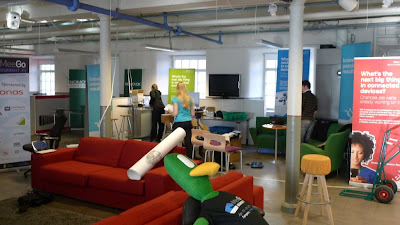
At the same time there is a lot of exciting stuff going on in the Ubuntu project (Ubuntu 11.04 upcoming, I'm already using it and reporting bugs), together with Linaro and other ARM players. As a founder of Ubuntu Finland I'm always eager to see if I can work there also on work time, not only on free time. And regarding ARM, Nomovok is the key player in having ARM on MeeGo as well.
Then on the completely other end of spectrum, I'm eagerly waiting for the GTA04 project to have my Neo FreeRunner(s) bumped up to modern specs. At the end of the day I'm still using over 2,5 year old phone myself, since I want to run the software that is both free and completely selected (and if I want, done) by me. With GTA04, I could choose between MeeGo armv7hl port, Debian armhf port or Ubuntu as the base distribution to use my software.

The company I work for, Nomovok's CEO illustrated the MeeGo situation extraordinarily well a little less than two months ago. I think it's one of the best insights you can get from anywhere in public at the moment. Now things are starting to really heat up. Of course the Big thing is the MeeGo Conference in San Francisco in the end of May, but it takes nothing away from this being the major event both in the country formerly known as NokiaLandia, and also globally given the amount of MeeGo related talent here. Nomovok is teasing people with the SteelRat - a launchpad for MeeGo tablet creation and an UX, based on latest MeeGo Core - a beta of which will be available now in Tampere and first version in San Fransisco. Meanwhile we and others are investing in also the MeeGo IVI and MeeGo TV platforms, not forgetting about the handset industry that is more visible to many tech savvy consumers.

At the same time there is a lot of exciting stuff going on in the Ubuntu project (Ubuntu 11.04 upcoming, I'm already using it and reporting bugs), together with Linaro and other ARM players. As a founder of Ubuntu Finland I'm always eager to see if I can work there also on work time, not only on free time. And regarding ARM, Nomovok is the key player in having ARM on MeeGo as well.
Then on the completely other end of spectrum, I'm eagerly waiting for the GTA04 project to have my Neo FreeRunner(s) bumped up to modern specs. At the end of the day I'm still using over 2,5 year old phone myself, since I want to run the software that is both free and completely selected (and if I want, done) by me. With GTA04, I could choose between MeeGo armv7hl port, Debian armhf port or Ubuntu as the base distribution to use my software.
Monday, January 31, 2011
Openmoko is dead, long live the Openmoko ...with ”GTA04” project
The 2008 product release, Openmoko Inc's – now in other business areas than mobile phones – Neo FreeRunner is finally starting to get a ”spiritual” successor, in form of the GTA04 project (not to forget about gta02-core project, either). Yes, the ”even schematics and cover CAD files are CC-BY-SA” free mobile phone is back... or at least if the German company Golden Delicious finishes what's it has been doing lately. Of course, the original FreeRunner is also still on sale as an improved version.
Since I have two FreeRunners, I look forward to replacing one of those with the new innards while keeping the other one as a daily phone while kernel and modem drivers get ready with the new platform. With a newer platform with ARMv7 instruction set, there would be easily also other ”traditional” distributions choices besides Debian to choose from, like Ubuntu or MeeGo. Both have oFono (+ telepathy etc.) packaged up, while Ubuntu also has a lot of the FreeSmartphone.Org (FSO) stack that has come to Ubuntu from Debian's pkg-fso team that I'm part of. Both software stacks are capable of getting updated with new modem drivers, although I think currently FSO has more daily / only phone users than oFono at this point of time still (I haven't yet heard of many Nokia N900 users using only free software distribution while using the phone functionality of such a distro as the one to count on).
So, a quote from today's Openmoko Community Updates:
---cut---
Since I have two FreeRunners, I look forward to replacing one of those with the new innards while keeping the other one as a daily phone while kernel and modem drivers get ready with the new platform. With a newer platform with ARMv7 instruction set, there would be easily also other ”traditional” distributions choices besides Debian to choose from, like Ubuntu or MeeGo. Both have oFono (+ telepathy etc.) packaged up, while Ubuntu also has a lot of the FreeSmartphone.Org (FSO) stack that has come to Ubuntu from Debian's pkg-fso team that I'm part of. Both software stacks are capable of getting updated with new modem drivers, although I think currently FSO has more daily / only phone users than oFono at this point of time still (I haven't yet heard of many Nokia N900 users using only free software distribution while using the phone functionality of such a distro as the one to count on).
So, a quote from today's Openmoko Community Updates:
---cut---
GTA04
GTA04 is a project by the long time distributor and hw developer, German company Golden Delicious. The name is loaned from Openmoko project because of the spiritual continuation - GTA01 was the codename for Neo1973, GTA02 was the Neo FreeRunner, and GTA03 was the canceled successor product. Besides offering improved versions of Neo FreeRunner (better battery life, better audio output), they've a complete replacement board planned to fit an existing Neo FreeRunner case and use the existing display.
The key details of GTA04 include among else:
- OMAP3530 ARMv7 CPU
- UMTS/3G (HSPA)
- USB 2.0 OTG
- WLAN, BT, FM transceiver
- Barometric Altimeter, Accelerometer, Compass, Gyroscope
- Optionally camera
Find your GTA04 information at the following addresses:
- http://www.gta04.org/ - technical: u-boot, kernel, Debian...
- http://www.handheld-linux.com/wiki.php?page=GTA04 - shopping page
- http://www.handheld-linux.com/wiki.php?page=GTA04-Early-Adopter - the early adopter program, although already finished
Latest news:
- gta04-owner mailing list founded, although occasionally you will find news also from the openmoko-community list among else; browse the list archives at http://lists.goldelico.com/pipermail/gta04-owner/
- First engineering sample (GTA04A2) is working in PDA mode (U-Boot in NAND Flash)
- GTA04A3 is getting final PCB layout fine tuning
- UMTS (3G) modules have arrived. And GTA04 likely to have 512 MB RAM, 512 MB NAND Flash and 1GHz DM3730 CPU. http://lists.goldelico.com/pipermail/gta04-owner/2011-January/000025.html
Visit the FOSDEM in Brussels, Belgium next weekend (5th/6th of February, 2011) to see GTA04 in action and discuss about it! See http://fosdem.org/2011/ , http://wiki.openmoko.org/wiki/FOSDEM_2011 , http://lists.openmoko.org/pipermail/community/2010-December/063899.html
---cut---Tuesday, November 30, 2010
Free Society Conference and Nordic Summit (FSCONS 2010)
Just a note that the slides are available (non-slideshare link) for my presentation ”Tuning an old but free phone” (description) that I held in the tremendously great event FSCONS 2010. It could be described as a smaller scale FOSDEM, but that would be actually down-playing it since the free software effects on society are something that I've actually never seen elsewhere on such a scale. My talk was among the purely technical ones, though.
I was planning to hold on with this blog post until the recorded videos arrive, but since it seems it might not be during this year I will just post this now that slides are available.
I've shared a few photos as well at Flickr...

Keynote: Karin Kosina, The Inanna Project. A tech + art workshop for female artists in Damascus, Syria. An experiment in art, technology, and the transformative power of Free Hardware and Software.

Erik de Bruijn, The Future of RepRap, a self-replicating open source 3D printer that fabricates arbitrary objects including parts of itself.

Social event at the Berg 211.

Malin Nilsson on Gender, class and global flows. Using free software to fuel a revolution in home based industrial work.

Keynote: Glyn Moody, Ethics of Intellectual Monopolies.

Keynote: Glyn Moody, Ethics of Intellectual Monopolies (audience).
A few summaries available on a Qaiku seminar channel.
I was planning to hold on with this blog post until the recorded videos arrive, but since it seems it might not be during this year I will just post this now that slides are available.
I've shared a few photos as well at Flickr...

Keynote: Karin Kosina, The Inanna Project. A tech + art workshop for female artists in Damascus, Syria. An experiment in art, technology, and the transformative power of Free Hardware and Software.

Erik de Bruijn, The Future of RepRap, a self-replicating open source 3D printer that fabricates arbitrary objects including parts of itself.

Social event at the Berg 211.

Malin Nilsson on Gender, class and global flows. Using free software to fuel a revolution in home based industrial work.

Keynote: Glyn Moody, Ethics of Intellectual Monopolies.

Keynote: Glyn Moody, Ethics of Intellectual Monopolies (audience).
A few summaries available on a Qaiku seminar channel.
Monday, November 01, 2010
Openmoko Community Updates 2010-11-01
(many exciting news from this old project/community working on the "Free Your Phone" idea, so as an publisher of the update sharing via blog as well. FreeRunner still available at eg. http://www.pulster.de/engl/index.html and the improved "+" versions at http://www.handheld-linux.com/wiki.php?page=Neo%20Freerunner, if an old/slow hardware is enough for you when you know you can tweak it to your liking)
Period 2010-09-01 to 2010-10-31
Distributions
 | Debian GNU/Linux Debian is a universal operating system used on many embedded devices, servers and home computers. Using Debian on the FreeRunner gives access to the huge army of software packaged in the Debian repositories, already compiled for the Neo's ARM(v4) processor. Moreover, one can build one's own source files for programs without having to learn the OpenEmbedded way. For an existing Debian/Ubuntu user, choosing Debian for Neo FreeRunner makes phone a very familiar, trustworthy and flexible place to hack in.
|
|
Applications
New Applications
 | aTrack 0.8 APRS tracker and communicator for mobile devices. It turns your Neo into bidirectional APRS unit and besides others it allows you to track your position, do text messaging, object creation or display stations around.
|
Application Updates
 | Gamerunner GnuBoy 0.8 A gameboy emulator which runs very nice, even with sound (sometimes it freezes, then you have to press the A button and everything is ok). You need the gamerunner distro or a gamepad to use it. Using frameskip to run smooth at 320*240 pixel. In second controll mode in gamerunner you can use savestates by pressing top right corne to save and left lower corner to load. Select is right lower corner.
|
 | FoxtrotGPS 1.0.0 FoxtrotGPS is an offshoot of Marcus Bauer's excellent Free & Open Source tangoGPS application, with a focus on cooperation and fostering community innovation. 1.0.0 announcement.
|
General News
Most important and change making mails on the mailing lists, blogs etc.. Coolest hacks, screenshots, themes etc..
GPRS
- GPRS on FreeRunner is unstable? Too many connections hang the modem? Unfixable? NO MORE! Our magician lindi has conjured a tc (traffic control) command that makes the data flow more stable even under heavy load. Huge thanks! http://docs.openmoko.org/trac/ticket/2264#comment:21 (use the lower one for faster operation)
Kernels
- Debian wiki now includes generic view on the multitude of Openmoko related kernel branches out there: http://wiki.debian.org/DebianOnFreeRunner#KernelBranchesinAutumn2010
- State of upstreaming kernel parts was updated by Lars-Peter Clausen and others in this thread: http://lists.openmoko.org/pipermail/openmoko-kernel/2010-September/011205.html - as always, help is welcome in the land of the kernel!
Spin-off Hardware Projects
- Another spin-off project possible: Always Innovating MiniBook would be a great basis for a free phone - it just lacks a GSM/3G chip... for now: http://lists.openmoko.org/pipermail/community/2010-October/063358.html
- Openmoko Beagle Hybrid moving to OMAP4/Cortex-A9: http://lists.openmoko.org/pipermail/community/2010-October/063437.html
Event News
- 2010-10-12 Next "FYP.de / Openmoko Stammtisch" in Munich, Germany [2]
- 2010-12-04 German Open Hard&Software Workshop on 4th/5th December 2010 in Munich; will cover Openmoko, Beagle Board, Arduino, OpenPandora, ...; still in planing phase; to stay and participate in planning loop please subscribe to: http://lists.goldelico.com/mailman/listinfo/open-hard-software-event
- 2011-01-24 Mobile FOSS MiniConf at LCA2011 announced a call for papers that closes on Friday 22nd October 2010. So submit something about OpenMoko today!
- 2011-02-05/06 FOSDEM 2011 calls for Main Speakers and Devrooms [3] that closes on Saturday 16th October 2010. So submit something about OpenMoko today!
Saturday, July 10, 2010
Unboxing and Tinkering Dell Latitude 2110 with Ubuntu 9.10
This entry includes a few photos of my Dell Latitude 2110 which shipped with Ubuntu 9.10 Netbook Remix. Mostly it's however a critical view on the software shipped. Critical simply because I investigate it quite closely to see how it could be improved especially when sold to end users in non-English countries in the future. The device itself is great, as is the Ubuntu shipped with it. The laptop has the 1.83GHz Atom N470 which is quite nice together with its integrated and battery saving graphics. I also chose 1366x768 resolution for the screen and 16GB SSD for storage. But anyway, this is not a review of any sort.
Currently Dell Latitude 2110 netbook is the only laptop available with Ubuntu in the Dell Finland's web store. A few others have specifications that list Ubuntu as a choice, but in the actual customization view there is no Ubuntu to be selected. So this is the only one, and also only for corporate customers - the web site even says "big companies". In reality though this is reflected in one and only place - there is a mandatory "Company" field in the order form. However, not even the company ID ("Y-tunnus") is required. I did use a company name there, but I wonder if they would care if one would just put "-" or "Ubuntu Finland" or anything there...


Software Observations
I boot it up, and was greeted first with a Dell EULA. Next up was familiar (Ubuntu 9.10 era) Ubuntu logo, white on black. Some churning and a set up wizard was presented:


It worked nicely otherwise, but even though I selected Finnish as the language, it first suggested US keyboard by default. This is in contrast to what normal Ubuntu installer does - offers Finnish keyboard as well.
After that the Ubuntu Netbook interface appeared, and I checked around a bit. Ubuntu 9.10 Netbook Remix shipped with Latitude 2110 seems quite default. No extra repositories. Extra software however is installed, noticed by simply looking through Ubuntu menus: they include Dell Recovery Media creation tool, Citrix Receiver and Vmware View Client.

Digging a bit deeper, I checked the package selection with Synaptic. The reason there are no extra repositories is that packages are installed without repositories. The following packages were "local or obsolete" after refreshing the normal Ubuntu repositories:
Local/main:
- alsa-driver-hda-intel-dkms (git.20100301)
- dell-recovery
- realtek-rts-pstor-card-driver-dkms
- vmware-view-client
UPDATE Sep 01, 2010: Added link to dell-recovery (in Ubuntu repositories) and especially the SD card reader (GPLv2). Patched ALSA shouldn't be needed for anything in Ubuntu 10.04 LTS anymore, and vmware-view-client is available elsewhere. The non-free stuff below are a) not that interesting and b) non-free, potentially non-distributable.
Local/non-free
- ctxusb
- icaclient
- libmotif4
- libmrm4
- libuil4
- libxm4
The great thing is that seemingly most of the customization is indeed done via packages. Great job with both that and correctly separating archive entries depending on whether the software is free or not. The packages themselves are located in the recovery partition of the hard drive.
Some more package observations:
- adobe-flashplugin is installed by default from Canonical partner repository (and the repository is enabled by default)
- besides it, no extra non-free software is installed, that is nothing from multiverse and only bcmwl-kernel-source from restricted
- also, nothing from universe
Language Problems
I didn't expect a fully Finnish laptop since the language of Ubuntu couldn't be selected when customizing the order, and I didn't get one. It's clear there is no effort yet put to actual localized offerings, but still it was possible to choose (any) language with the first boot of Latitude 2110.
Language problems are quite ok at this point since the device is not being sold as a localized home user product yet. Nevertheless, it's good to list issues that need to be fixed before localized devices can be sold. At least in Finnish, dunno how's the state of for example Inspiron 10 devices shipped in Germany and elsewhere to also end users via web.
Number two problem regarding languages software was (number one being the wrong suggested keyboard) that full Finnish support was not offered to be installed (and it wasn't installed by default). Since the selection of language was possible during first run, suggesting download of or automatically downloading language support should be done. Normal Ubuntu does it also in Ubuntu 9.10 just nicely also in the cases that installation is done without Internet connection / full language support, so somehow Dell has unfortunately disabled that feature or not allowing it to run. The hook that checks the language support and shows a message is included in language-selector, the message itself in file /usr/share/language-support/incomplete-language-support-gnome.note.
I ran Language Selector manually, which fixed the problem and indeed works fine nowadays in Ubuntu. However, I also noticed that in Language Selector "For my menus and windows, use" had "English (United States)" selected, so only the second item had Finnish selected. It seems therefore that the setting up of the language during setup wizard doesn't do a complete job anyway for the new user created at least. Only after selecting it manually did the language tool correctly download and enable all the needed support for my language.
The Only Big Problem (...that was fixed)
Now for the only big WTF during my tinkering:
/etc/apt/apt.conf.d/00secure containing lines:
APT::Get::AllowUnauthenticated "true";
Aptitude::CmdLine::Ignore-Trust-Violations "true";
This simply leads to eg. synaptic package manager complaining about all upgrades being unauthenticated, and elsewhere possible well needed warnings are simply not shown. I have no idea what's the basis for shipping this kind of security hindering settings with the laptop.
UPDATE: This was later fixed in Ubuntu as a security issue, see CVE-2010-0834.
What Next
After these observations and being quite happy with a laptop that has Ubuntu straight out-of-the-box (which also saved 80€ of money + taxes compared to default OS), I created a recovery ISO image with Dell's tools and then I let Update Manager upgrade Ubuntu to 10.04.
Ubuntu 10.04 LTS was smooth enough already, but I also upgraded latest Intel graphics drivers from xorg-edgers. My only irritation is the Broadcom WLAN driver 'wl'. It works just fine in 10.04 LTS. The irritation is the amount of battery eating wakeups it generates even when there is no traffic going on. AFAIK it's a non-free driver from the vendor, and once again it's one of those that works in principle but is miles from being a well behaving kernel driver. It seems the free b43 driver does not support the BCM43224 chipset (14e4:4353) yet, so unfortunately I'm currently stuck with this driver. Luckily the laptop (and Ubuntu) is otherwise so great on using power, that I still get 5+ hours of battery usage at least (haven't measured much yet).
I'm very happy with what Dell is doing. I do hope the consumer sales would soar (and become available in Finland in the first place via the consumer retail channels there already exist). I also hope the language support bugs would be fixed - it's not tremendously hard, I could probably fix and test all the problems myself if I'd be given the task. Maybe the new Ubuntu 10.04 LTS offerings will already have some of it working better. All in all the Dell Latitude 2110 with Ubuntu 9.10 Netbook Remix was a problem-free ride, and had I simply used it in English it would have worked out-of-the-box smooth as butter.
Currently Dell Latitude 2110 netbook is the only laptop available with Ubuntu in the Dell Finland's web store. A few others have specifications that list Ubuntu as a choice, but in the actual customization view there is no Ubuntu to be selected. So this is the only one, and also only for corporate customers - the web site even says "big companies". In reality though this is reflected in one and only place - there is a mandatory "Company" field in the order form. However, not even the company ID ("Y-tunnus") is required. I did use a company name there, but I wonder if they would care if one would just put "-" or "Ubuntu Finland" or anything there...


Software Observations
I boot it up, and was greeted first with a Dell EULA. Next up was familiar (Ubuntu 9.10 era) Ubuntu logo, white on black. Some churning and a set up wizard was presented:


It worked nicely otherwise, but even though I selected Finnish as the language, it first suggested US keyboard by default. This is in contrast to what normal Ubuntu installer does - offers Finnish keyboard as well.
After that the Ubuntu Netbook interface appeared, and I checked around a bit. Ubuntu 9.10 Netbook Remix shipped with Latitude 2110 seems quite default. No extra repositories. Extra software however is installed, noticed by simply looking through Ubuntu menus: they include Dell Recovery Media creation tool, Citrix Receiver and Vmware View Client.

Digging a bit deeper, I checked the package selection with Synaptic. The reason there are no extra repositories is that packages are installed without repositories. The following packages were "local or obsolete" after refreshing the normal Ubuntu repositories:
Local/main:
- alsa-driver-hda-intel-dkms (git.20100301)
- dell-recovery
- realtek-rts-pstor-card-driver-dkms
- vmware-view-client
UPDATE Sep 01, 2010: Added link to dell-recovery (in Ubuntu repositories) and especially the SD card reader (GPLv2). Patched ALSA shouldn't be needed for anything in Ubuntu 10.04 LTS anymore, and vmware-view-client is available elsewhere. The non-free stuff below are a) not that interesting and b) non-free, potentially non-distributable.
Local/non-free
- ctxusb
- icaclient
- libmotif4
- libmrm4
- libuil4
- libxm4
The great thing is that seemingly most of the customization is indeed done via packages. Great job with both that and correctly separating archive entries depending on whether the software is free or not. The packages themselves are located in the recovery partition of the hard drive.
Some more package observations:
- adobe-flashplugin is installed by default from Canonical partner repository (and the repository is enabled by default)
- besides it, no extra non-free software is installed, that is nothing from multiverse and only bcmwl-kernel-source from restricted
- also, nothing from universe
Language Problems
I didn't expect a fully Finnish laptop since the language of Ubuntu couldn't be selected when customizing the order, and I didn't get one. It's clear there is no effort yet put to actual localized offerings, but still it was possible to choose (any) language with the first boot of Latitude 2110.
Language problems are quite ok at this point since the device is not being sold as a localized home user product yet. Nevertheless, it's good to list issues that need to be fixed before localized devices can be sold. At least in Finnish, dunno how's the state of for example Inspiron 10 devices shipped in Germany and elsewhere to also end users via web.
Number two problem regarding languages software was (number one being the wrong suggested keyboard) that full Finnish support was not offered to be installed (and it wasn't installed by default). Since the selection of language was possible during first run, suggesting download of or automatically downloading language support should be done. Normal Ubuntu does it also in Ubuntu 9.10 just nicely also in the cases that installation is done without Internet connection / full language support, so somehow Dell has unfortunately disabled that feature or not allowing it to run. The hook that checks the language support and shows a message is included in language-selector, the message itself in file /usr/share/language-support/incomplete-language-support-gnome.note.
I ran Language Selector manually, which fixed the problem and indeed works fine nowadays in Ubuntu. However, I also noticed that in Language Selector "For my menus and windows, use" had "English (United States)" selected, so only the second item had Finnish selected. It seems therefore that the setting up of the language during setup wizard doesn't do a complete job anyway for the new user created at least. Only after selecting it manually did the language tool correctly download and enable all the needed support for my language.
The Only Big Problem (...that was fixed)
Now for the only big WTF during my tinkering:
/etc/apt/apt.conf.d/00secure containing lines:
APT::Get::AllowUnauthenticated "true";
Aptitude::CmdLine::Ignore-Trust-Violations "true";
This simply leads to eg. synaptic package manager complaining about all upgrades being unauthenticated, and elsewhere possible well needed warnings are simply not shown. I have no idea what's the basis for shipping this kind of security hindering settings with the laptop.
UPDATE: This was later fixed in Ubuntu as a security issue, see CVE-2010-0834.
What Next
After these observations and being quite happy with a laptop that has Ubuntu straight out-of-the-box (which also saved 80€ of money + taxes compared to default OS), I created a recovery ISO image with Dell's tools and then I let Update Manager upgrade Ubuntu to 10.04.
Ubuntu 10.04 LTS was smooth enough already, but I also upgraded latest Intel graphics drivers from xorg-edgers. My only irritation is the Broadcom WLAN driver 'wl'. It works just fine in 10.04 LTS. The irritation is the amount of battery eating wakeups it generates even when there is no traffic going on. AFAIK it's a non-free driver from the vendor, and once again it's one of those that works in principle but is miles from being a well behaving kernel driver. It seems the free b43 driver does not support the BCM43224 chipset (14e4:4353) yet, so unfortunately I'm currently stuck with this driver. Luckily the laptop (and Ubuntu) is otherwise so great on using power, that I still get 5+ hours of battery usage at least (haven't measured much yet).
I'm very happy with what Dell is doing. I do hope the consumer sales would soar (and become available in Finland in the first place via the consumer retail channels there already exist). I also hope the language support bugs would be fixed - it's not tremendously hard, I could probably fix and test all the problems myself if I'd be given the task. Maybe the new Ubuntu 10.04 LTS offerings will already have some of it working better. All in all the Dell Latitude 2110 with Ubuntu 9.10 Netbook Remix was a problem-free ride, and had I simply used it in English it would have worked out-of-the-box smooth as butter.
Thursday, May 06, 2010
Ubuntu 10.04 LTS release fest in Tampere, Finland
The main release party in Finland was held at Tampere, Finland and organized by Ixonos Plc and COSS. It was a great success, as proven by the almost 200 participants and great speakers.
The first sessions were mostly about the basics of Ubuntu and its roots in Debian and elsewhere. Then Tuure Vartiainen from Tampere University of Technology shared with us the release from the official Finnish mirror perspective (fi.archive.ubuntu.com, fi.releases.ubuntu.com, ...). 10.04 LTS release date was very hectic and the transfer speeds were not constantly optimal, but quite good anyway. For 10.10 they hope to up the network connectivity to 10G. I also took the opportunity to thank him later personally for the Ubuntu Finnish Remix mirroring which was arranged right before the release as well.
The next-to-final session was about Ubuntu for senior people with brief demoing of how Ubuntu UI can be customized. To give a little different perspective to usage of Ubuntu, the final speaker was a theater director and dramatist Jotaarkka Pennanen from Interactive Film Productions. Blender among else was praised.
In addition to speakers, we had 300 Ubuntu Finnish Remix CD:s, Ubuntu posters, Free Software Foundation Europe flyers, COSS flyers et cetera. After the main program there was a dinner and some wine offered to participants, which was a great social ending to the event.
Now a few photos follow. Unfortunately they are from before the event actually began, so others have probably more crowded photos and photos of the speakers themselves.


The first sessions were mostly about the basics of Ubuntu and its roots in Debian and elsewhere. Then Tuure Vartiainen from Tampere University of Technology shared with us the release from the official Finnish mirror perspective (fi.archive.ubuntu.com, fi.releases.ubuntu.com, ...). 10.04 LTS release date was very hectic and the transfer speeds were not constantly optimal, but quite good anyway. For 10.10 they hope to up the network connectivity to 10G. I also took the opportunity to thank him later personally for the Ubuntu Finnish Remix mirroring which was arranged right before the release as well.
The next-to-final session was about Ubuntu for senior people with brief demoing of how Ubuntu UI can be customized. To give a little different perspective to usage of Ubuntu, the final speaker was a theater director and dramatist Jotaarkka Pennanen from Interactive Film Productions. Blender among else was praised.
In addition to speakers, we had 300 Ubuntu Finnish Remix CD:s, Ubuntu posters, Free Software Foundation Europe flyers, COSS flyers et cetera. After the main program there was a dinner and some wine offered to participants, which was a great social ending to the event.
Now a few photos follow. Unfortunately they are from before the event actually began, so others have probably more crowded photos and photos of the speakers themselves.


Friday, February 12, 2010
Ubuntu 10.04 and 3G modems – usb-modeswitch or not?
I'm writing a blog entry instead of just replying to myself on a mailing list, since this subject might be interesting to a largish portion of the community. Most people assume things just magically work out by themselves and then after a release wonder why it wasn't so.
So, I raised a question on ubuntu-devel-discuss mailing list about whether usb-modeswitch should be included in the default Ubuntu 10.04 LTS installation instead of it only being in the universe repository. Reason was simply that firstly, I've read some general wonderings from the community about why it isn't already so. Secondly, without it my 3G modem (Huawei E1552) was first not functional, but right after installing usb-modeswitch package Network Manager worked smoothly with it.
Since I didn't get much discussion going on besides some statements that it doesn't work for everybody and even has caused extra problems for some others (in 9.10), I asked for a small round of comments on the subject on IRC. The channels are logged so I believe I can quote those a bit.
Colin Watson said among else:
So there we are now. Apparently at this point it is hoped that as many quirks as possible are inserted in the kernel, see for example drivers/usb/storage/unusual_devs.h in the kernel. But if you have concerns about if 10.04 LTS will be kept up-to-date regarding 3G modems and want to somehow participate in bringing usb-modeswitch into Ubuntu default installation or simply discuss how to handle the kernel SRUs properly, it's time to stand up and do something.
Should there perhaps be a process with which the usb-modeswitch developers would get the information they are gathering more easily to the upstream kernel _and_ (older) distribution kernels? Is this simply a case of being easier to address an issue with a "hackish" approach, or is the usb-modeswitch actually the right way to go?
Note that I'm no expert in this area, I simply become interested in various subject from time to time :)
-Timo, going to figure out a kernel quirk for his 3G modem
So, I raised a question on ubuntu-devel-discuss mailing list about whether usb-modeswitch should be included in the default Ubuntu 10.04 LTS installation instead of it only being in the universe repository. Reason was simply that firstly, I've read some general wonderings from the community about why it isn't already so. Secondly, without it my 3G modem (Huawei E1552) was first not functional, but right after installing usb-modeswitch package Network Manager worked smoothly with it.
Since I didn't get much discussion going on besides some statements that it doesn't work for everybody and even has caused extra problems for some others (in 9.10), I asked for a small round of comments on the subject on IRC. The channels are logged so I believe I can quote those a bit.
Colin Watson said among else:
"surely we just want the kernel to DTRT [do the right thing] by default ... this is the upstream trend ... it already DTRT for quite a few devices"Later on Paul Sladen continued a bit, among else:
"I'd be very concerned about advertising that it's the Way to get things to work, and thus undermining getting things fixed in the kernel"
"I agree that usb-modeswitch is often a way to get otherwise non-working hardware to work ... I'm just not very convinced it's a real properly supportable option"
"but I'm just another user from this point of view, albeit one who ended up in quite a few discussions with various appropriate upstreams last time round :)"
"usb-modeswitch is a very long-winded way of sending a single usb-mass-storage command to the device's first profile"Meanwhile I also IM:d a bit with Antti Kaijanmäki from whom I probably originally coined the idea of following whether usb-modeswitch is integrated into Ubuntu or not. He mainly said that he doubts the feasibility of updating kernel's USB storage quirks in a stable release, compared to having stable release upgrades about the usb-modeswitch-data udev rules. He also proposed discussing maintainability and usability by distros with the Debian maintainer and upstream, although it sounds like Colin might have had some talks already.
"grep -hr MessageContent usb_modeswitch.d/ | sort -n | uniq -c | sort -rn shows the level of duplication in the configuration files"
"...I do like that it is done in userspace though, as so easy to disable if you wanted something else".
So there we are now. Apparently at this point it is hoped that as many quirks as possible are inserted in the kernel, see for example drivers/usb/storage/unusual_devs.h in the kernel. But if you have concerns about if 10.04 LTS will be kept up-to-date regarding 3G modems and want to somehow participate in bringing usb-modeswitch into Ubuntu default installation or simply discuss how to handle the kernel SRUs properly, it's time to stand up and do something.
Should there perhaps be a process with which the usb-modeswitch developers would get the information they are gathering more easily to the upstream kernel _and_ (older) distribution kernels? Is this simply a case of being easier to address an issue with a "hackish" approach, or is the usb-modeswitch actually the right way to go?
Note that I'm no expert in this area, I simply become interested in various subject from time to time :)
-Timo, going to figure out a kernel quirk for his 3G modem
Saturday, January 30, 2010
Neo FreeRunner "A7+" now available
Thanks to Dr. H. Nikolaus Schaller's efforts, a new "A7+" version of the world's only 100% free software (and even free hardware design, leading to further community development) phone, Neo FreeRunner, is available for sale at www.handheld-linux.com for 299€! New in this hardware version is prolonged battery life, due to a fix applied to the famous "#1024" bug. Now you should have theoretically about 5 days time suspended, but that's of course only if you don't actually do anything with this phone-computer.
In other news, despite the fact or because Openmoko Inc. has ceased its development efforts for now at least, concentrating on the WikiReader to recover from the economic problems, community finally questioned the reasoning behind some of the Linux kernel debug configuration in the official Openmoko kernel branch. Results? Speedup of certain kernel operations in the range of 2x to 5x! In practice that means Neo isn't actually anymore the sluggish device you used to get to know with. Of course it's not top of the line by any means, but being the only Free phone available on the market still, more free than most full-size computers in fact, it's a quite nice improvement to eg. boot time, application start up time et cetera. I merely was a messenger of these news from the kernel mailing list to the community, but I also provided a readily compiled kernel which I use in Debian and which seems to works for others as well (until their distributions package it up).
Over 1,5 years after launch of the FreeRunner, and even more since the original Neo 1973, the software is getting better all the time. The pace is slow, as is the case with any free/open project with limited community-only resources, but the best thing is that it never has to stop. A lot of the middleware, applications and so on will make it to future phones as well. Things like Intone music player, TangoGPS and literki keyboard might be nice little finger-usable applications in the future as well.
So, if you can manage without 3G and want to still have an unique mobile computer experience with basic phone functionality, running for example Debian for the "familiar experience" if you use Debian or Ubuntu on your other computers, it's still not too late to catch it. It seems we're still a couple of years away from any next effort of such level of freedom. I'm making through it by having bought a 59€ 3G modem for the more serious data needs. I'm still also thinking about a privoxy setup on my home server that would clean up and compress pages even via Neo's GPRS connection.
In other news, despite the fact or because Openmoko Inc. has ceased its development efforts for now at least, concentrating on the WikiReader to recover from the economic problems, community finally questioned the reasoning behind some of the Linux kernel debug configuration in the official Openmoko kernel branch. Results? Speedup of certain kernel operations in the range of 2x to 5x! In practice that means Neo isn't actually anymore the sluggish device you used to get to know with. Of course it's not top of the line by any means, but being the only Free phone available on the market still, more free than most full-size computers in fact, it's a quite nice improvement to eg. boot time, application start up time et cetera. I merely was a messenger of these news from the kernel mailing list to the community, but I also provided a readily compiled kernel which I use in Debian and which seems to works for others as well (until their distributions package it up).
Over 1,5 years after launch of the FreeRunner, and even more since the original Neo 1973, the software is getting better all the time. The pace is slow, as is the case with any free/open project with limited community-only resources, but the best thing is that it never has to stop. A lot of the middleware, applications and so on will make it to future phones as well. Things like Intone music player, TangoGPS and literki keyboard might be nice little finger-usable applications in the future as well.
So, if you can manage without 3G and want to still have an unique mobile computer experience with basic phone functionality, running for example Debian for the "familiar experience" if you use Debian or Ubuntu on your other computers, it's still not too late to catch it. It seems we're still a couple of years away from any next effort of such level of freedom. I'm making through it by having bought a 59€ 3G modem for the more serious data needs. I'm still also thinking about a privoxy setup on my home server that would clean up and compress pages even via Neo's GPRS connection.
Monday, November 23, 2009
Ubuntu Developer Summit and zombies
Part two of my random selection of photos follows. As for the UDS sessions participation, the rest of the week went in translations, Debian and mobile related discussions. Mostly translations/I18N whenever available, since those were a) primary reason for my sponsorship and b) I've had the most to contribute to Ubuntu in that area in the past, at least considering the visibility / impact.
I was happy to be able to participate to the second gun range visit. Otherwise it would not have felt I actually stepped out of the hotel, since I was too late on Monday for the first round and totally missed the ice skating thing.
The only thing hindering my UDS experience was total lack of good night's sleep. It seems I'm not much of a traveler in that aspect. Mostly the coffee and the pure hecticness of UDS were able to overcome the problem, but from time to time I'd just liked to sleep for 12 hours, which I finally did back home.
Thanks to all, that amount of hugely intelligent people in one place was quite an experience, together with the pace of the sessions. I do hope to see you again, preferably with a little more free time.
 I don't know if you noticed it was possible to shoot classical kind of city photos from...
 ...the roof of our hotel.
 Even though I flew away before Friday's Ubuntu Allstars, I was able to get some glimpses of the musical talent available at UDS.
 This is just a proof I did see day-light during the trip.
 Dell talk.
 Zombies got shot...

 ...by this neat group of zombie hunters.
I was happy to be able to participate to the second gun range visit. Otherwise it would not have felt I actually stepped out of the hotel, since I was too late on Monday for the first round and totally missed the ice skating thing.
The only thing hindering my UDS experience was total lack of good night's sleep. It seems I'm not much of a traveler in that aspect. Mostly the coffee and the pure hecticness of UDS were able to overcome the problem, but from time to time I'd just liked to sleep for 12 hours, which I finally did back home.
Thanks to all, that amount of hugely intelligent people in one place was quite an experience, together with the pace of the sessions. I do hope to see you again, preferably with a little more free time.
 I don't know if you noticed it was possible to shoot classical kind of city photos from...
 ...the roof of our hotel.
 Even though I flew away before Friday's Ubuntu Allstars, I was able to get some glimpses of the musical talent available at UDS.
 This is just a proof I did see day-light during the trip.
 Dell talk.
 Zombies got shot...
 ...by this neat group of zombie hunters.
(note my GIMP skills to include everyone)
Subscribe to:
Posts (Atom)